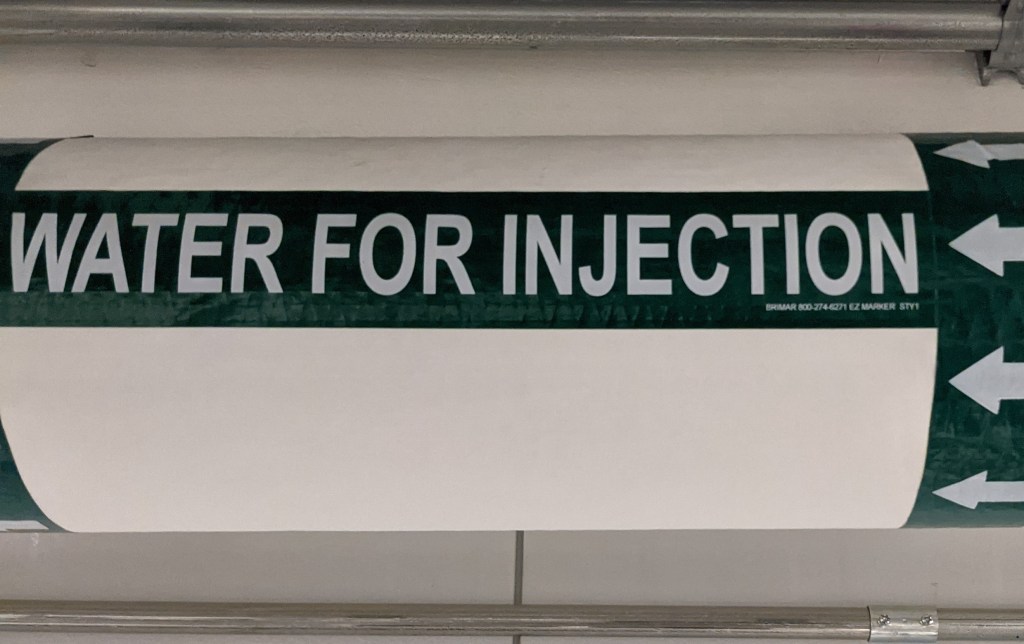
The final version of Annex 1 to Volume 4 of the EU Guidelines for Good Manufacturing Practice for Medical Products for Human and Veterinary Use was published in Eudralex 4 on August 25, 2022 and will become effective one year later August 25, 2023. It contains a new section specifically devoted to water systems. Written for sterile product manufacturing, the regulations would presumably be applicable to Water or Injection (WFI) systems, although the guidance will likely extend to Purified Water Systems and pharmaceutical water systems more broadly.
After years of revisions and comments from industry, the final section on water is remarkably consistent with cGMPs and good engineering practice. However, a few subsections are worth reviewing as they may affect current industry practices..
Requirements That May Require Assessment
- Sloped piping is referenced as an example in two different sections. Although sloped piping can facilitate draining of piping networks and assemblies, the scientific benefit for sloped piping is questionable. If drainability is not part of a normal system function (e.g. draining of condensate after steam sterilization), designing, installing, and validating piping systems for complete sloping does not reduce microbial risk.
- A requirement that was not in previous drafts of the annex, states the flow rate should be routinely monitored in distribution systems. Certainly not all current WFI distribution networks include continuous flow monitoring. Flow meters are often omitted using the following rationale:
- Effort to minimize the number of connections in sanitary tubing networks.
- Difficulty or cost to calibration flow instrumentation.
- Turbulent flow can be validated for all operational ranges during system validation.
- Benefit from constantly monitoring flow in distribution loops is questionable.
- Flow not considered as critical as other process parameters for microbial control
- Pre and post use integrity testing of bacterial retentive hydrophobic vent filters on WFI storage tanks is considered a cGMP requirement, although it is not universally performed. Some system owners will execute only a pre or post integrity test. Others will forgo testing altogether, relying on filter manufacturer test certificates and noting the risk associated with atmospheric contamination for WFI tanks that are continuously ozonated or maintained at a temperature greater than 70𝆩C is minimal. This requirement should put more emphasis on this testing in the future.
Noticeably Absent
- Although the use of non-distillation, membrane based technologies for the production of WFI is referenced, the use of ozone as a sanitization method is excluded. This is noteworthy as the majority of membrane based WFI generation systems are coupled with continuously ozonated WFI storage tanks. Mention of continuous recirculation of water at a temperature of greater than 70°C should not preclude the use of ozone as an acceptable sanitizing agent.
Affirmation of Other cGMP Requirements
The following cGMPs were also cited in the Annex and are consistent with current industry practices.
| Requirement | Harmonized Regulations & Guidance* |
| Nature of contamination controls commensurate with risk. Importance of risk assessment | ICH, FDA guidance, WHO guidance |
| Continuous monitoring and trending of data especially for Critical Process Parameters (CPPs) and Critical Quality Attributes (CQAs) | ICH, PIC/S guidance, FDA guidance, WHO guidance, USP guidance |
| Minimum temperature of 70°C for microbial control | FDA guidance (>65°C), EMA guidance (>75°C), USP guidance (>65°C) |
| RO/EDI/UF for WFI generation is appropriate | USP/EP/JP, EMA guidance, FDA guidance, WHO guidance |
| Alert levels based on data (not arbitrary) and periodically reassessed | USP guidance |
| Worst case sampling location should be included in sampling protocol | USP guidance |
| At least one sample every day that the water is used for manufacturing | FDA guidanceNote: Although frequency of sampling is ultimately a function of system operation, performance, and risk, it is common practice to sample at least once point in WFI distribution systems everyday the water is used for manufacturing purposes |
| Continuous monitoring for TOC and conductivity | EMA guidance, FDA guidance, USP guidance, WHO guidance |
*All of these requirements are consistent with ISPE guidelines which are generally considered the most exhaustive, current documents for pharmaceutical water systems’ best practices.
Ultimately, the impact of Annex 1 on pharmaceutical water systems will be determined by how the language is interpreted and enforced by regulating agencies. Already adopted by PIC/S, a global impact on pharmaceutical water system cGMPs for not only WFI systems but also Purified Water Systems is expected. Fortunately, changes to the Water System Section of Annex 1 influenced by public comment have resulted in a final document that is well harmonized with other international pharmacopeiae and industry guidance documents.
 IonClear